

Technology Guide
How to choose a UV lamp
Wavelength first, then power, then geometry. A step-by-step guide to matching a UV curing light source to your material and process.
Technology Guide
How a narrow band of UV LED light cures coatings, inks and adhesives as parts or webs move past, and how to size a linear source for your line speed.
A linear light source produces a long, narrow band of UV light. Mounted across a conveyor, a web or a rotating part, it cures the material as it passes underneath. Linear curing is the natural choice whenever the product moves: printing and coating lines, conveyors, long bond lines and cylindrical parts that turn under the lamp.
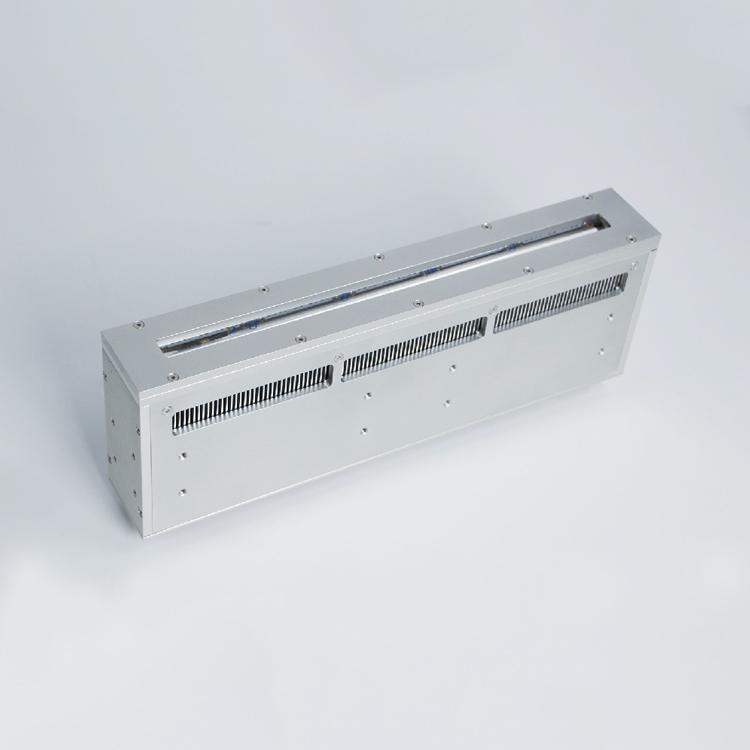
The light source is a row of UV LEDs behind a window, typically 3 to 10 mm wide and from about 10 mm to more than a metre long. A controller sets the output and switches the LEDs on and off, either continuously while the line runs or triggered by a sensor as each part arrives.
Every point on the product receives light only while it is under the band. The dose it collects therefore depends on three things: the irradiance under the lamp, the width of the irradiated band and the speed at which the product moves.
Irradiance (mW/cm²) is the UV power per unit area reaching the surface. Dose (mJ/cm²) is the energy per unit area, built up over the time a point spends under the lamp:
As an illustration, a band 10 mm wide on a line moving at 10 m/min (about 167 mm/s) gives a dwell time of 0.06 s. At an average irradiance of 1,000 mW/cm², that is about 60 mJ/cm² per pass.
Two consequences follow. Doubling the line speed halves the dose. And a higher peak irradiance does not raise the dose if the band becomes narrower. To reach a higher dose at the same speed, use a source with more output, a wider emitting area, several sources in a row, or more passes.
The irradiance across a linear source is not perfectly flat: it peaks in the centre of the band and falls off towards the edges and the ends. Measure the actual dose with a radiometer that travels through the curing zone on the conveyor and records the accumulated energy.
Line sources are usually specified at a working distance of about 10 mm. The band widens and the irradiance falls as the distance increases, so mount the source as close to the product as the process allows, at a fixed and repeatable height. On conveyors with adjustable lamp height, re-measure after each change.
Linear sources are available at 365, 385, 395 and 405 nm. Use the wavelength your ink, coating or adhesive is formulated for. 365 nm suits many adhesives and formulations derived from mercury-lamp chemistry; 385 and 395 nm are widely used for LED-curable inks and coatings; 395 and 405 nm penetrate further into thick or pigmented layers.
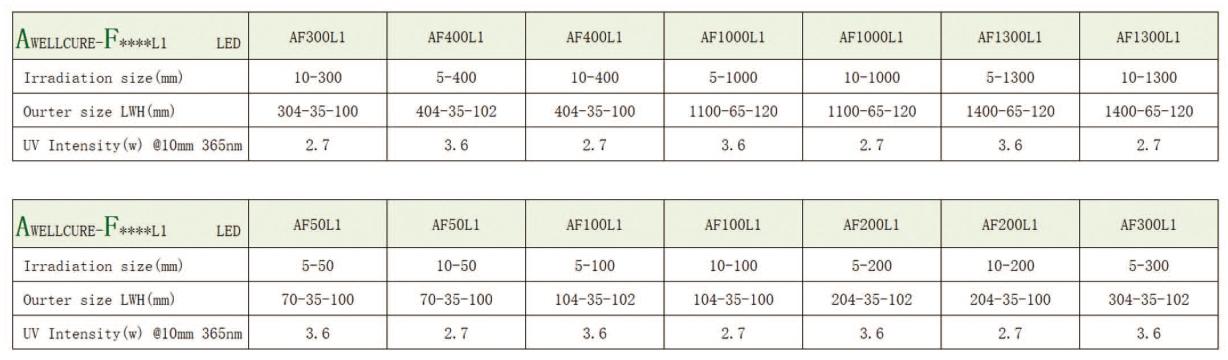
Awellcure UV LED Linear sources range from compact 10 × 3 mm and 15 × 5 mm heads for narrow bond lines to fan-cooled bars from 50 × 10 mm up to 1,350 × 10 mm for web and conveyor widths. For higher irradiance in a line format, the water-cooled 20 mm wide sources in the UV LED Area range reach 6 to 25 W/cm². Their controllers accept external trigger signals from a PLC, sensor or foot switch, provide status and alarm outputs, and can be programmed through RS232.
Technology Guide
Wavelength first, then power, then geometry. A step-by-step guide to matching a UV curing light source to your material and process.
Technology Guide
How focused UV LED heads cure adhesive exactly where it is dispensed, and how to choose lenses, wavelength and controller for precise bonding of small parts.
Technology Guide
How UV LED area sources cure whole parts, trays and coated surfaces in one exposure, and how to size the emitting area, irradiance and cooling.
Expert advice
Tell us about your parts, adhesive or coating and cycle time, and we recommend a spot, linear or flood system.