

Technology Guide
How to choose a UV lamp
Wavelength first, then power, then geometry. A step-by-step guide to matching a UV curing light source to your material and process.
Technology Guide
How focused UV LED heads cure adhesive exactly where it is dispensed, and how to choose lenses, wavelength and controller for precise bonding of small parts.
Spot curing concentrates UV light on a small, well-defined area, typically a few millimetres across. It cures a dispensed dot or bead of adhesive exactly where it sits, in seconds, while the rest of the part stays largely unexposed. It is the standard technique for bonding small parts in electronics, optics, fibre optics and medical device assembly.
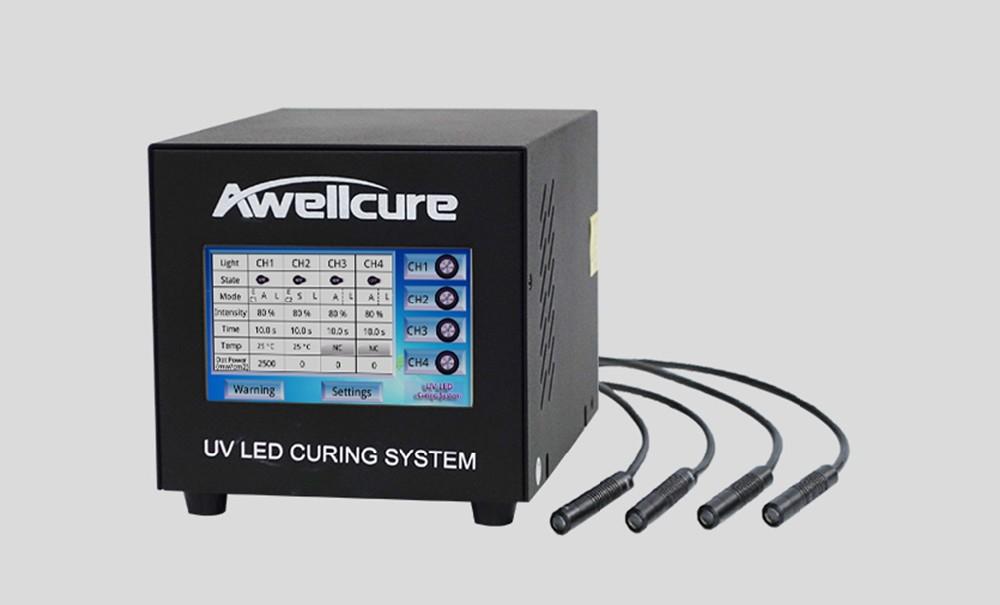
A UV LED spot system has three parts:
The adhesive is dispensed, the parts are positioned, and the controller switches the LED on for a set time. Because the LED is at full output immediately and switches off without delay, the exposure is defined by the controller alone, with no warm-up and no shutter.
Before UV LEDs, spot curing used a mercury lamp and a flexible light guide. LED heads replace that with a source that runs for tens of thousands of hours, emits no infrared and contains no mercury. Lamp-based UV Lamp Spot systems remain useful for adhesives that need a broad spectrum.
The lens shapes the light into a spot of a given diameter at a given distance from the head. Small spots concentrate the LED's output and reach the highest irradiance; large spots spread it over more area and reach less. Each lens is specified at a nominal working distance, measured from the head to the part.
| Part No. | Spot size(mm) | Working distance(mm) | Max. irradiance(mW/cm²) |
|---|---|---|---|
| ASHL02 | 2 | 8 | 18,000 |
| ASHL03 | 3 | 10 | 13,000 |
| ASHL04 | 4 | 14 | 8,500 |
| ASHL05 | 5 | 16 | 7,280 |
| ASHL06 | 6 | 17 | 5,980 |
| ASHL08 | 8 | 27 | 2,340 |
| ASHL10 | 10 | 25 | 1,820 |
| ASHL12 | 12 | 25 | 1,040 |
| ASHL15 | 15 | 38 | 650 |
The table shows the trade-off clearly: the 2 mm lens reaches 18,000 mW/cm², the 15 mm lens 650 mW/cm². Choose the smallest spot that still covers the whole adhesive bead with some margin for positioning tolerance.
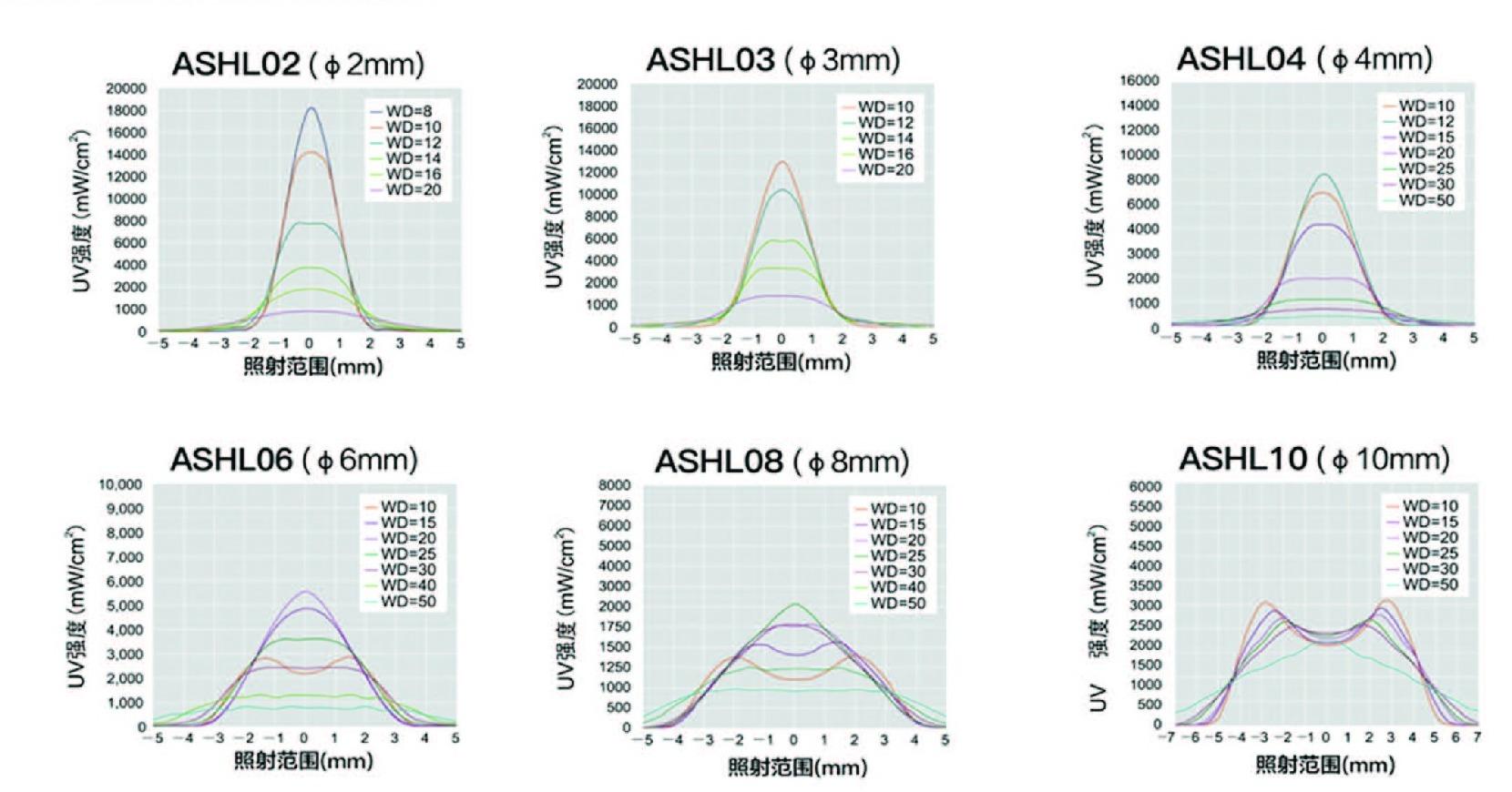
Moving the head away from its nominal distance changes both the peak and the shape of the spot. The irradiance profiles below show this for six lenses: at the nominal distance the profile is narrow and high; further away it becomes lower and wider. Fix the head in a holder at a repeatable distance, and re-measure if the fixture changes.
Besides the standard round spot, special lenses produce a linear spot for short bond lines or emit at a right angle for heads that have to be mounted parallel to the part.

Two numbers describe the exposure:
Adhesive data sheets usually state a required dose and often a minimum irradiance. Both matter. Below a certain irradiance, oxygen at the surface can stop the cure, and a longer exposure does not fully compensate. Above it, a higher irradiance shortens the exposure time for the same dose. Very high irradiance can also cure the adhesive so quickly that shrinkage stress builds up, which is why step or pulse irradiation is useful for precision bonds.
Measure irradiance at the working position with a UV Radiometer when you set up the process, and repeat the measurement at regular intervals.
Spot heads are available at 365, 385, 395, 405 and 450 nm. The right choice is set by the adhesive:
Use the wavelength recommended in the adhesive data sheet, and check the transmission of any layer the light passes through.
Awellcure UV LED Spot controllers drive four or eight heads, each with its own intensity, exposure time and mode, set in steps of 0.1 s. They can be triggered from external signals, output an alarm for a faulty head, lock their settings and log operating hours per head. Each head has a temperature sensor feeding back to the controller, which keeps irradiance within ±3 % at 80 % output. Heads come with a 2 m cable as standard, with 5 m or longer to order, and robot-grade cables are available for moving heads.
Technology Guide
Wavelength first, then power, then geometry. A step-by-step guide to matching a UV curing light source to your material and process.
Technology Guide
How a narrow band of UV LED light cures coatings, inks and adhesives as parts or webs move past, and how to size a linear source for your line speed.
Technology Guide
How UV LED area sources cure whole parts, trays and coated surfaces in one exposure, and how to size the emitting area, irradiance and cooling.
Expert advice
Tell us about your parts, adhesive or coating and cycle time, and we recommend a spot, linear or flood system.